
Great Plains: Opportunities to Build Resilience - NCA Key Message 5
Summary
 Show caption
 Hide
Hide![[creative commons]](/images/creativecommons_16.png)
NCA Key Message 5
visit the full Opportunities to Build Resilience page
The magnitude of expected changes will exceed those experienced in the last century. Existing adaptation and planning efforts are inadequate to respond to these projected impacts.
1. Guiding Questions
- Think of 2 resilience plans you would make to lower the intensity of climate change in the Plains.
- What is the importance of building a resilience plan?
- Explain the importance of at least 3 climate change adaptations that human and natural systems would benefit from.
2. Key figures
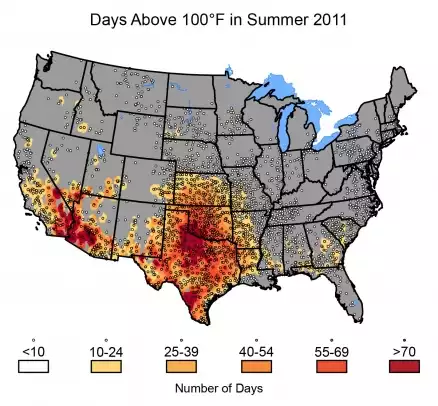
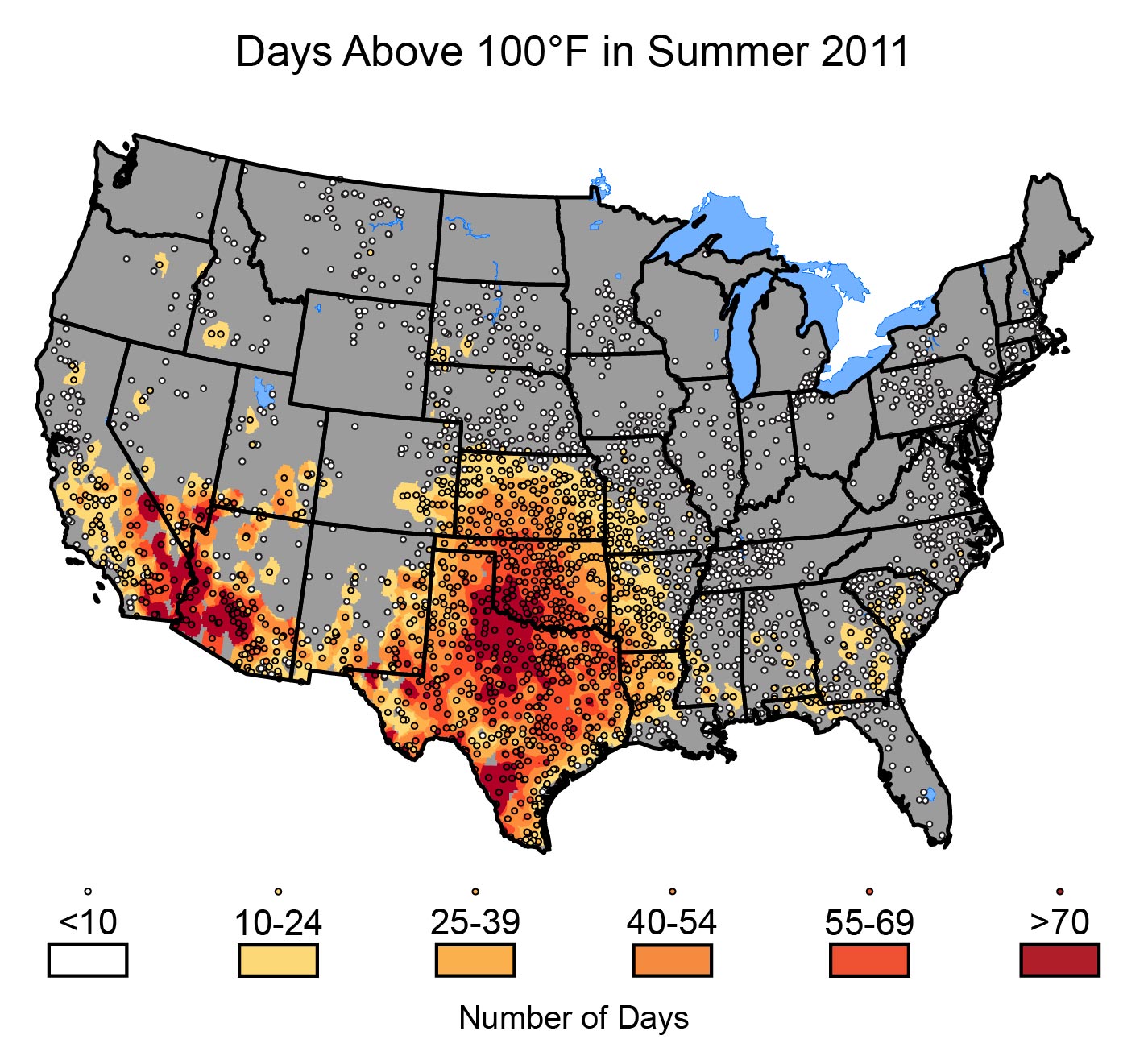
Days Above 100 Degrees Fahrenheit in Summer 2011
In 2011, cities including Houston, Dallas, Austin, Oklahoma City, and Wichita, among others, all set records for the highest number of days recording temperatures of 100°F or higher in those cities' recorded history. The black circles denote the location of observing stations recording 100°F days.
3. Other Resources
Austin, Texas prepares for climate change with departmental climate plans
Each municipal department in Austin, Texas is responsible for developing customized departmental climate plans that detail how the department will reduce greenhouse gas emissions.
Private organizations protect wetlands in the Great Plains
Private organizations play an important role in protecting valuable wetland resources in the Great Plains. Although many of the plans to protect wetlands are not motivated explicitly by climate change, preserving wetlands helps the ecosystems be more resilient to changes — including climate change.
Wyoming outlines a strategy to protect wildlife from climate change impacts
4. Lesson Plans
Climate Change Adaptation and Mitigation
Cartoon animation focusing on adapting to climate change, specifically in Wisconsin, by helping the community prepare for changes that are already impacting the region.
Level: Middle 6-8, High School 9-12, and informal Direct Link
Greenhouse Emissions Reduction Role-Play Exercise
In this role-play activity, students take the roles of various important players in the climate change policy debate including politicians, scientists, environmentalists, and industry representatives. Working in these roles, students must take a position, debate with others, and then vote on legislation designed to reduce greenhouse gas emissions in the United States. Can be used in a variety of courses including writing and rhetoric, and social sciences.
Level: High School; 9-12, College Lower , and College Upper Direct Link
5. Videos
Creating Modern Solutions for Environmental Challenges
Helping producers manage climate change
Helping Producers Manage Climate Change
This video is an introduction to a series of new Climate Hubs developed by USDA. Seven hubs and 3 sub-hubs are located in existing USDA research facilities, in partnership with USDA's Forest Service, Agricultural Research Service and Natural Resources Conservation Service, and with Land Grant Universities in seven major regions of the U.S. USDA partners also include the U.S. Department of Interior and NOAA. These hubs will address strategies for risk adaptation and mitigation to climate change, and focus on delivering these strategies to land owners, farmers, ranchers and forest land owners.
Disclaimer:
The National Climate Assessment regional resources for educators is written, edited, and moderated by each team of contributors. Posts reflect the views of the team themselves and not necessarily Climate.gov, NOAA, or USGCRP.
Contributors:
Contributors: Kristen Poppleton, Will Steger Foundation
Sarah Evans, Will Steger Foundation
References and Resources
Citation
NOAA, N. (2014). Great Plains: Opportunities to Build Resilience - NCA Key Message 5.