
Module: Arctic Ecosystems - UCAR COMET
Summary
![[creative commons]](/images/creativecommons_16.png)
This module was developed by COMET - UCAR, Publish Date: 2010
- Languages: English, Spanish
- Skill Level: Upper High School and Undergraduate
- Completion Time: 1.00 - 1.25 hours
- Includes Audio: yes
- Required Plugins: Flash
- Topics: Climate, Marine Meteorology/Oceans, Other
- Requires sign in
Scientists predict that the climate in most parts of the world will warm dramatically in the next century, with change expected to occur earliest and be most pronounced in polar regions. In light of this, there is an urgent need to understand different aspects of the Earth's climate system, including the role that Arctic ecosystems play in regulating the Earth's climate and how food webs are affected by the changing climate. This module explores the Arctic Ocean ecosystem through interaction with a model that simulates how phytoplankton and zooplankton interact and respond to changes in season, sea ice, and nutrients.
Learning Goals
Context for Use
Description and Teaching Materials
Teaching Notes and Tips
Assessment
Arctic Ecosystems Quiz Included
Note: At the request of COMET sponsors, this quiz is designed to demonstrate your successful completion of the module. Because the quiz is being administered online, upon completion you will be given only feedback on which questions you answered correctly and incorrectly. No additional instructional feedback is provided. However, should you need to, you can use this information to revisit the module to determine how to answer correctly and then attempt the quiz again.
References and Resources
COMET: Greenhouse Effect: http://www.meted.ucar.edu/broadcastmet/brazil/print.htm#page_1.4.0
from the COMET module The Amazon Rainforset and Climate Change.
Hunt, G.L. Jr., Stabenob, P., Waltersc, G., Sinclaird, E., Brodeure, R.D., Nappc, J.M., Bondf, N.A., 2002: Climate change and control of the southeastern Bering Sea pelagic ecosystem. Deep-Sea Research II, 49,5821-5853. http://www.sciencedirect.com/science/article/pii/S0967064502003211
Li, W.K.W., McLaughlin, F.A., Lovejoy, C., and Carmack, E.C., 2009: Smallest Algae Thrive As the Arctic Ocean Freshens. Science, 326, 539. http://www.sciencemag.org/cgi/content/full/326/5952/539
NSIDC: Sea Ice Albedo: http://nsidc.org/seaice/processes/albedo.html
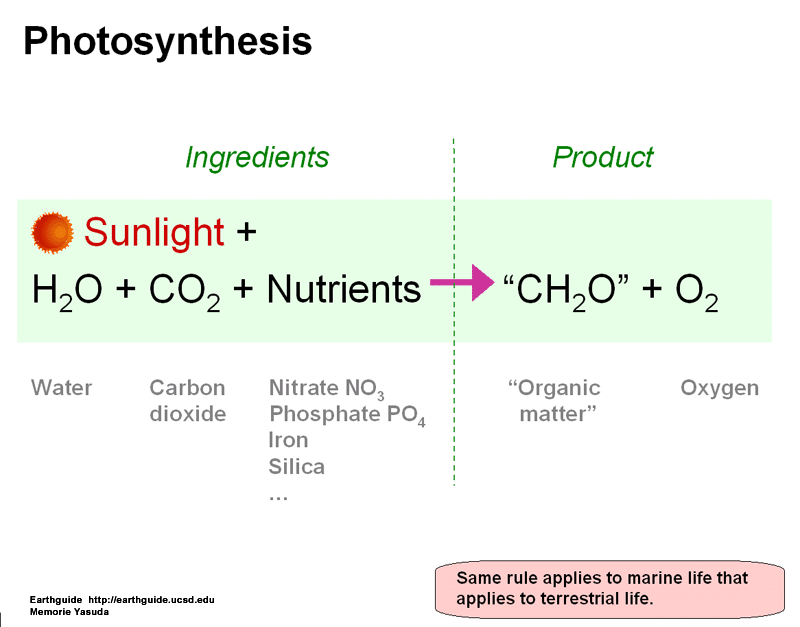
UCSD Earth Guide: Photosynthesis: http://earthguide.ucsd.edu/events/TeacherTECH_2005/equation_photosynthesis.gif
Weir, J. (1999), Changing currents color the Bering Sea a new shade of blue. http://earthobservatory.nasa.gov/Features/Coccoliths/
Woods Hole Oceanographic Institution: Dive and Discover: The Arctic Ecosystem: http://www.divediscover.whoi.edu/arctic-ecosystem/index.html
Citation:
The source of this material is the COMET® Website at http://meted.ucar.edu/ of the University Corporation for Atmospheric Research (UCAR), sponsored in part through cooperative agreement(s) with the National Oceanic and Atmospheric Administration (NOAA), U.S. Department of Commerce (DOC). ©1997-2011 University Corporation for Atmospheric Research. All Rights Reserved.