Video: AK-03 ALASKA: AK-03 Columbia Glacier "Cliff" (Narrated) - CLEAN
Initial Publication Date: April 29, 2016
Summary

![[creative commons]](/images/creativecommons_16.png)
Provenance: Eli Maynard
Reuse: This item is offered under a Creative Commons Attribution-NonCommercial-ShareAlike license http://creativecommons.org/licenses/by-nc-sa/3.0/ You may reuse this item for non-commercial purposes as long as you provide attribution and offer any derivative works under a similar license.
This activity has been selected for inclusion in the CLEAN Collection based on the following review comments:
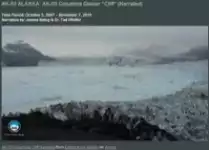
A video from the Extreme Ice Survey in which Dr. Tad Pfeffer and photographer Jim Balog discuss the dynamics of the Columbia glacier's retreat in recent years through this time-lapse movie. Key point: glacier size is being reduced not just by glacial melting but due to a shift in glacial dynamics brought on by climate change.
Video length: 1:20 min.
About the Science
- Dr. Pfeffer and Jim Balog touch on the combination of human climate change pushing the glacier and natural dynamics taking over.
- In addition to warming temperatures, topography plays a role in the rapid flow speeds at Columbia Glacier.
- The Extreme Ice Survey is the most wide-ranging glacier study ever conducted using ground-based real-time photography to document the rapid changes now occurring on the Earth's glacial ice.
- Passed initial science review - expert science review pending.
Description and Teaching Materials
Video >> AK-03 ALASKA: AK-03 Columbia Glacier "Cliff" (Narrated)
![[reuse info]](/images/information_16.png)
Reuse: If you wish to use this item outside this site in ways that exceed fair use (see http://fairuse.stanford.edu/) you must seek permission from its creator.
Technical Details/Ease of Use
Teaching Notes and Tips
Should be used in conjunction with other time lapse videos and related background materials on glacier retreat as evidence of climate change.
While there are other background materials on the EIS website, this and related narrated videos provide an overview of the time-lapse movies of Arctic glaciers retreating due to natural process coupled with human impacts on the climate system.
No pedagogy is provided.
This video is a short 1.20 minutes of time lapse photography/video, yet conveys key points quite powerfully nonetheless.
Video would have to be accompanied by lessons on glacier retreat and impact on climate change.
Very good website for students to check out, with other similar clips available on the Extreme Ice Survey website.
Assessment
Assessment is at the discretion of the educator as to how the resource is used.
References and Resources
Provenance: Eli Maynard
Reuse: This item is offered under a Creative Commons Attribution-NonCommercial-ShareAlike license http://creativecommons.org/licenses/by-nc-sa/3.0/ You may reuse this item for non-commercial purposes as long as you provide attribution and offer any derivative works under a similar license.
