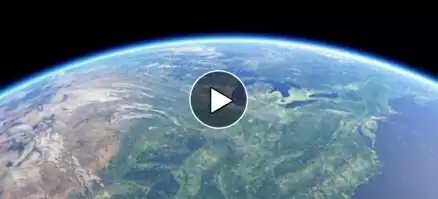
Video: Earth's Operating Manual - Program I of mini series
Summary
![[creative commons]](/images/creativecommons_16.png)
54 minutes, 2011 version
Program 1 in the Earth: The Operators' Manual mini-series, hosted by award-winning geoscientist, Richard Alley. Explains the essential science of climate change, and the promise of renewable energy to provide for humans' need for energy. Introduces unusual suspects in the discussion of global warming, the US Pentagon and wind farmers in West Texas.
In New Zealand, we go deep into a crevasse in the Franz Josef Glacier to understand how the advance and retreat of massive glaciers during Earth's Ice Ages is tied to changing levels of carbon dioxide. In Denver, Colorado, we peer over Alley's shoulder at the National Ice Core Lab to see how records of temperature and atmospheric composition trapped inside chunks of ancient ice conclusively demonstrate that today's levels of CO2 are higher than at any time in the past 400,000 years, due largely to our burning of fossil fuels over the past several hundred years. And we see why the Pentagon now believes that climate change is real and how responding to those challenges is part of the military's future strategic objectives.
Then it's on to locations where developments in sustainable energy, and a diverse cast of inspiring Earth "operators," are already proving it's possible to do things differently. A solar power plant near Seville, Spain, provides electricity to 200,000 homes – promising news for the sunniest place in the world, the deserts of the U.S. Southwest, where solar energy could provide for 80% of Earth's current use.
On the North Island of New Zealand, a geothermal generating station is a reliable source of carbon-free energy. Next up, Brazil, a land of cars running on flex fuels using sugarcane ethanol; then it's on to the gas-guzzling city of Houston, which under the leadership of Mayor Annise Parker is working to support e-vehicles and get fifty percent of its power from wind by 2030. In a fascinating and surprising segment filmed at the Army's Fort Irwin and the Marine Corps' Camp Pendleton, members of the U.S. military explain why they have made it a priority to significantly reduce reliance on fossil fuels. And in Xi'an, Shanghai and Beijing, we see how China, the world's largest energy consumer, is evolving from "the factory of the world" into "the clean-tech laboratory of the world," in the words of Peggy Liu, chairperson of the Joint U.S.-China Collaboration on Clean Energy.
This special dispenses with controversy, partisan debates and political stalemates and focuses on the beauty and bounty of the planet, human ingenuity, and the many reasons to be optimistic about our future. As Alley says, if enough of us get involved, "we can avoid climate catastrophes, improve energy security, and make millions of good jobs."
Learning Goals
An operator's manual helps keep your car or computer running at peak performance. Earth science can do the same for the planet. To illustrate the evidence and the way forward, host Richard Alley, takes viewers on a High-Definition trip around the globe, from New Zealand to New Orleans, telling the story of Earth's climate history and our relationship with fossil fuels.
Context for Use
Description and Teaching Materials
Watch >> Earth's Operating Manual - Program I
Teaching Notes and Tips
Provides Annotated Script.
Assessment
empty
References and Resources